
Free PDF Guide
How To Build A High Performing & Highly Profitable Engineering Team
Created Specifically For Engineering Consultancies
Build a high performing engineering team that generates incredible profits & frees you up to focus on strategy, direction & the high-growth activities that will move the needle the most & make the biggest difference
The 3 Hires That Will Change Your Consultancy Forever
Most engineering and built environment consultancy owners hire when they're desperate.
Someone quits.
A project blows up.
The owner is drowning.
And so they hire fast, reactive, and usually for the wrong role.
The consultancies that grow consistently do it differently.
They make three specific hires, in the right order, at the right time.
— Hire One: Admin Support (Start to $1M) —
You're doing everything.
Chasing invoices. Scheduling meetings. Answering emails.
And somewhere in between — you're supposed to be winning & delivering work.
Admin support gets the low-level tasks off your plate so you can focus on growth.
It sounds simple. But for most owners at this stage — it's the unlock.
— Hire Two: Strong Seniors ($1M to $3M) —
You're running every project, managing every client, reviewing everything.
The business can only grow as fast as you can personally carry it.
High-quality seniors break that ceiling.
T...
Why Hiring More People Won’t Fix Your Profit
This is one of the most common mistakes I see consultancy owners make.
Things are stretched. Margins are tight. The team is under pressure.
And the instinct is: we need to hire.
But here's the reality —
Hiring more people won't fix your profit. In fact, if you get the timing wrong, it'll make things worse.
In this week's podcast episode, I break down exactly why — and what to do instead.
Inside this episode we cover:
- Why every hire reduces profit before it improves it — and what the real lag looks like
- Why throwing people at problems is often avoidance of the real issue
- Why 7 or 8 times out of 10, it's not a people problem — it's a systems and process problem
- Why growth phases are meant to feel messy — and where profit is actually built
- The Growth → Consolidation → Rest model and why the most profitable phase is the one most owners skip
I also share a brilliant win from Mandy inside our Boardroom community — who just h...
Why Growth Plateaus Are Actually Good For Your Consultancy
Most consultancy owners I work with have experienced this at some point.
Revenue is growing. The team is expanding. Things are moving fast.
And then…
Everything plateaus.
Growth slows. Forward movement stalls.
And suddenly you start asking yourself — what's wrong with the business?
Here's the truth:
Nothing is wrong.
Growth plateaus are not a problem. In fact, they're often one of the most important phases in building a strong consultancy.
In this week's podcast episode, I unpack why business growth rarely happens in a straight line — and why the plateau phase is actually where the real foundations of a great business get built.
Inside this episode we cover:
- Why strong consultancies grow in cycles, not straight lines.
- Why plateau phases are where systems, structure and team capability get built.
- How to stop reacting emotionally to slowed growth and use the period strategically.
- The difference between chasing r...
You're Saying Yes to the Wrong Things

Most engineering and built environment consultancy owners build their business by saying yes.
Yes to every client.
Yes to every project.
Yes to every opportunity that comes through the door.
And it works — until it doesn’t.
Because at a certain point, saying yes to everything means saying no to the things that actually matter.
The consultancy owners who are stuck right now aren't stuck because they're not working hard enough.
They're stuck because they're saying yes to the wrong things.
Yes to the client who grinds on price and drains the team.
Yes to the project that only works if the owner is in the middle of it.
Yes to staying involved in delivery instead of leading the business.
Yes to doing tasks that someone else should own.
And no — by default — to the things that would actually move the needle.
The shift happens when you flip it.
Yes to clients who value your expertise and pay without hesitation.
Yes to hiring people who ...
Want the "How to Thrive in a Slower Market" Workshop Replay?
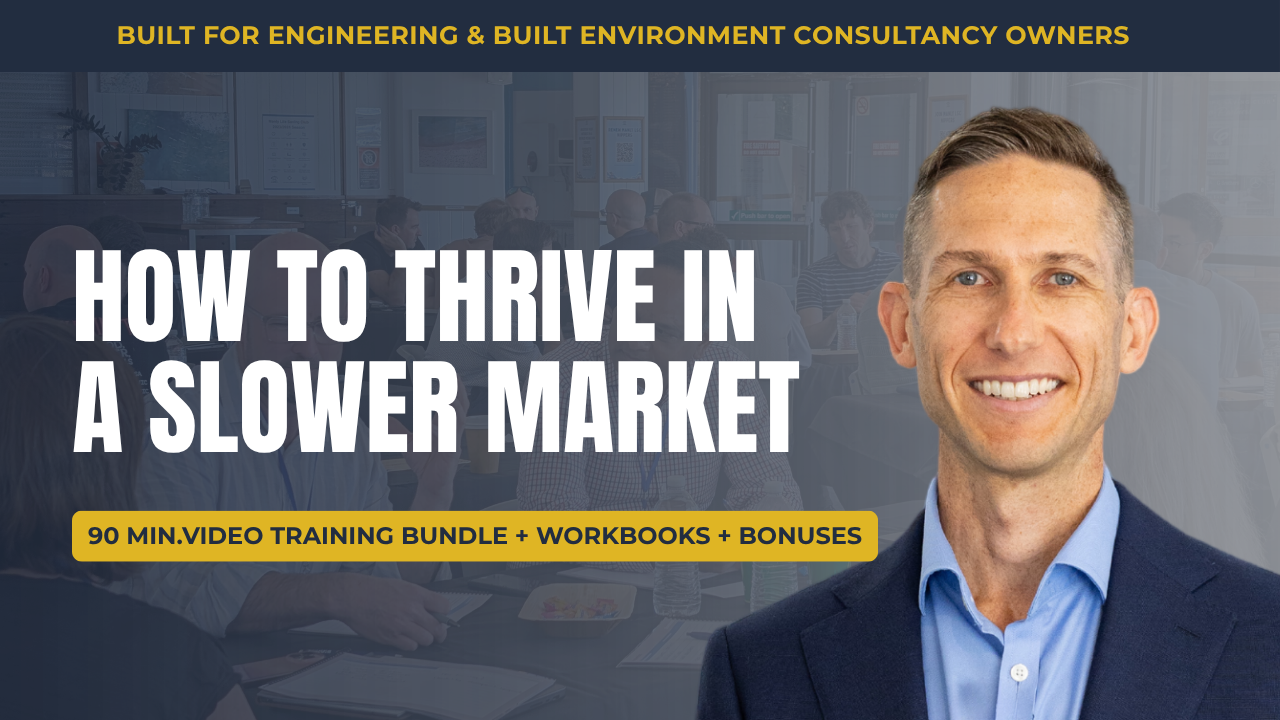
Yesterday's "How to Thrive in a Slower Market" workshop was one of the most grounded, practical and strategic sessions I've run on how to position your consultancy to win in any market conditions.
Engineering and built environment consultancy owners showed up ready to get ahead of the curve — and walked away with a clear picture of where the market is heading and a plan they can implement immediately.
And the feedback's been great:
"Walking away with a clear plan and ready to implement."
"This completely changed how I'm thinking about the next 18 to 24 months for my business."
"Great session Josh. Heaps of stuff I can action this week."
A few people reached out saying they couldn't make it live — so I'm making the full replay available until Friday.
Grab the replay here to watch at your convenience >> Click Here
You'll get access to everything included in the workshop:
✔️ The proven strategies that work in the engineering and built environment indust...
Let's Get Your Consultancy Positioned For What's Coming
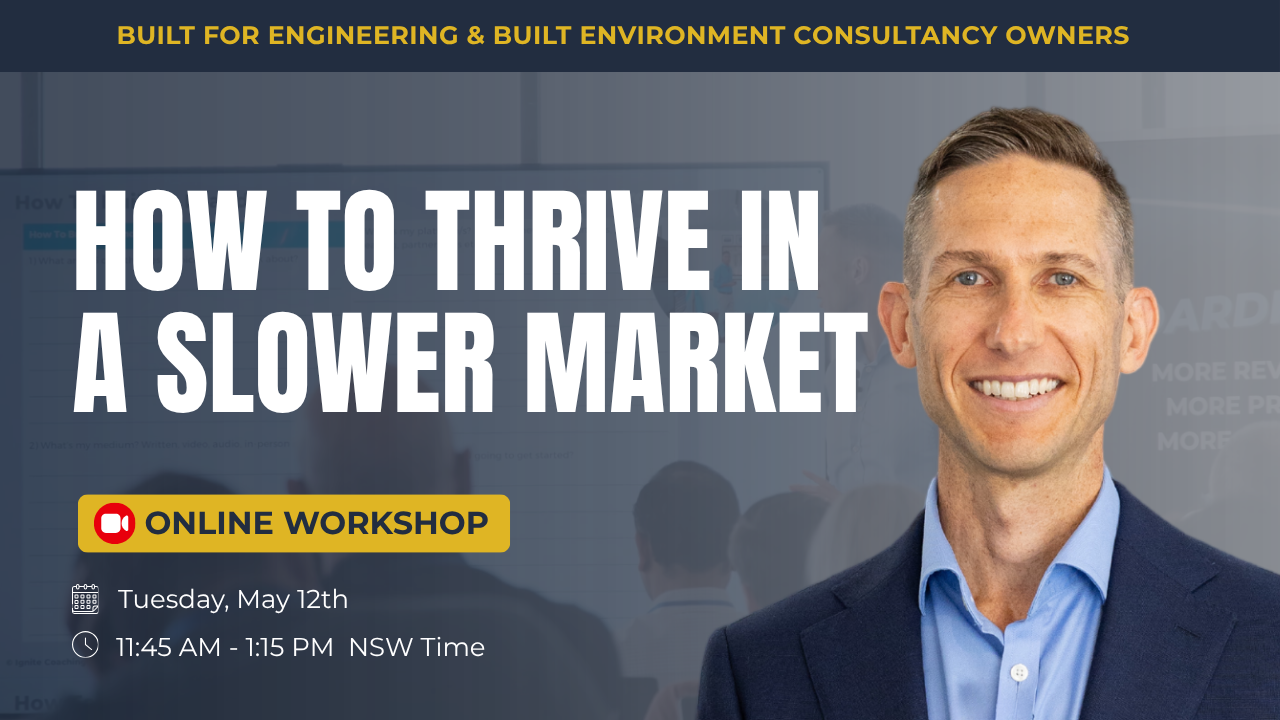
Next Tuesday I'm running an online workshop called "How to Thrive in a Slower Market."
It's designed to give you a clear picture of where the market is heading over the next 18 to 24 months — and help you install the proven strategies to position your consultancy to capitalise and thrive in any market conditions.
If you're watching the market headlines and wondering what it means for your consultancy…
If you're starting to notice clients taking longer to make decisions or fewer projects available to bid on…
Or you want to make sure your business is positioned to win — whatever the next 18 to 24 months looks like…
This is your chance to get ahead of it.
I'll walk you through exactly how to:
— Identify where the real opportunities are over the next 18 to 24 months and how to get in front of them early
— Know which sectors will keep growing regardless of the broader economy, and make sure you're in the right place at the right time to capitalise
— Get ...
Why Hoarding Cash Is Quietly Slowing Your Growth
Most consultancy owners I work with are actually pretty good at making money.
But a surprising number of them are sitting on large cash balances in their business bank account — and doing nothing with it.
No real plan. No deliberate deployment. Just a growing number that feels safe.
Here's the problem: money that isn't working isn't helping you grow.
In this week's podcast episode, I unpack why hoarding cash inside your consultancy can quietly become one of the biggest bottlenecks to your next phase of growth — and what to do instead.
Inside this episode we cover:
- Why a business bank account is not an investment strategy.
- How delaying hires and not building systems keeps you trapped in the day-to-day.
- The real cost of not investing in operational support.
- How to shift your relationship with money — from protection mode to deployment mode.
- How to put capital to work, whether inside the business or building wealth outside of it.
The 5 Things Holding Consultancy Owners Back
After working with more than 150 consultancy owners across engineering and the built environment — the patterns are pretty clear.
Most founders are working incredibly hard.
But their growth keeps stalling for the same few reasons.
Not market reasons.
Not team reasons.
Not timing reasons.
The same five reasons.
Every time.
In this week's episode, I sit down with Doron Dinor — one of our coaches inside Boardroom — to unpack exactly what those five things are and what to do about them.
Inside this episode we unpack:
- Why staying in the technician role is quietly capping your growth.
- How to break the feast and famine cycle for good.
- Where profit margin erosion comes from — and how to stop it.
- Why plateaus are part of the process and what to do when you hit one.
- How a clear plan eliminates decision fatigue and puts you back in control.
If you run a consultancy and growth has slowed or become harder than it should be...
Money Is Great - But This Is Better...
A new car is nice.
A share portfolio is smart.
A growing business feels good.
But none of that is the real reason we got into business.
The real reason?
Choice and freedom.
Choice about what you work on.
And what you don't.
Choice about who you hire.
What clients you take on.
And which ones you politely walk away from.
Freedom to go to the gym at lunch — without asking anyone's permission.
Freedom to take a Friday off and turn it into a long weekend.
Freedom to just…not work.
And sit on the sideline at your kids' sports carnival knowing the business is running.
That's what this is really about.
Not the revenue number.
Not the car in the driveway.
This life.
And having a business that supports it.
We only get one life.
And it's too short to be doing things we don't want to be doing.
And here's the thing —
If you feel like you've got the business, but not the freedom…
I...
This Really P!sses Me Off

“Can you make your fees a bit cheaper”?
I guarantee this question gets asked in our industry
Every… single… day…
We don’t ask Doctors to be cheaper
We don’t ask Woolies to “shave 10% off their price of ham”
Or the Physio to “throw in a session for free”
So why is it OK for your clients to ask you to be cheaper…?
What do you think?
Why do they keep asking?
Send me an email at [email protected] and let me know.
Josh
PS: If you’re interested, here are 4 ways I can help you right now:
- Grab a copy of my new book | Profitable Engineering Consultant | 9 strategies to grow with confidence, get your time back & consistently hit 30% plus net profit margins – Click Here
- Subscribe to our podcast | Learn how to run a more profitable consultancy and grow successfully – no fluff, just actionable and practical advice from someone who grew a consultancy to $30M and exited successfully – Watch Here or Listen Here + make sure y...


